Introducing Agent Mode

Alex Yudovich
February 11, 2026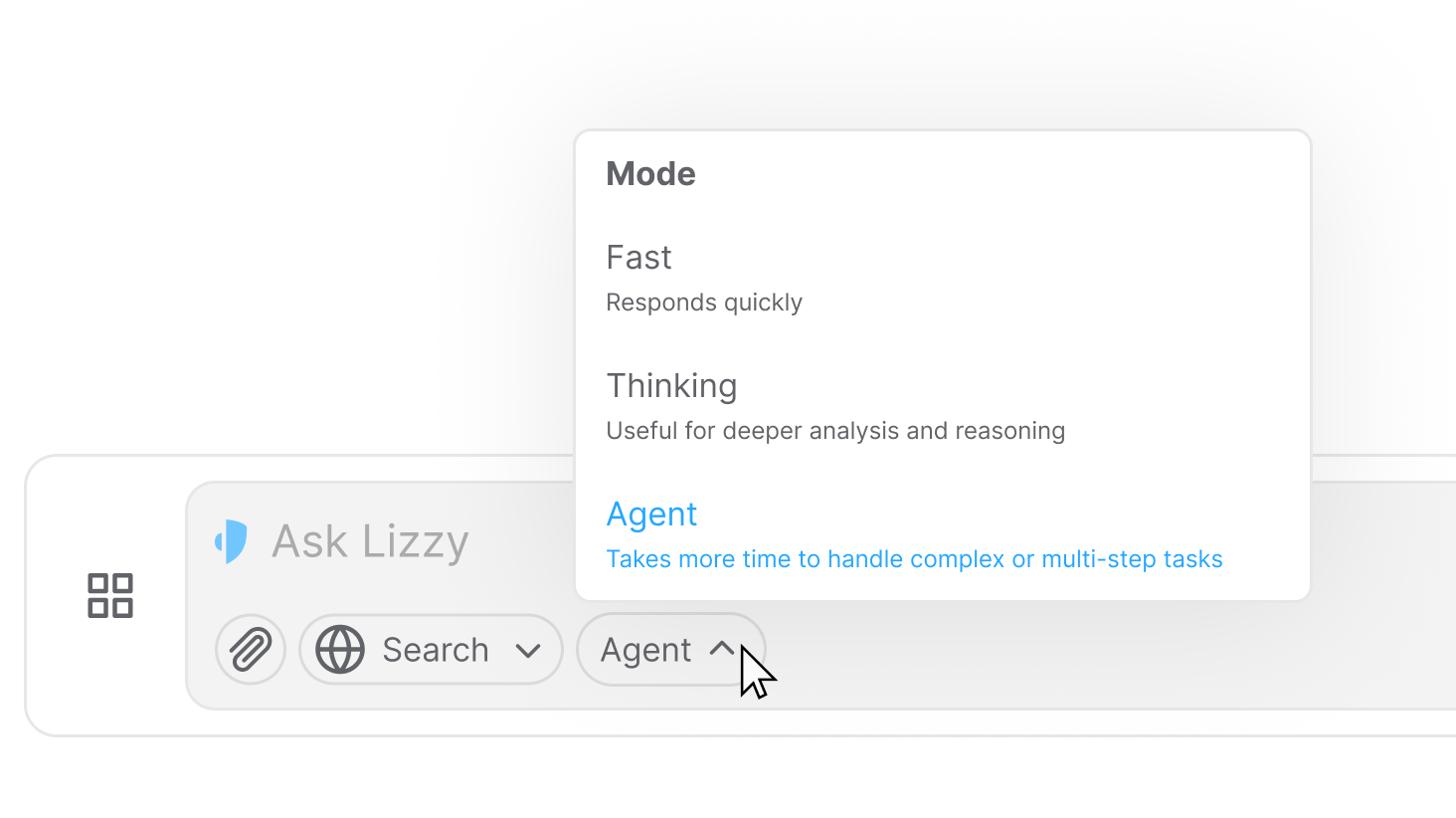
Fast mode is great for quick answers. Thinking mode goes deeper with more deliberate reasoning. Agent Mode takes the next leap - executing legal work step by step, iterating when needed, and improving coverage across long documents and multi-instruction workflows.
The Most Thorough Way to Run Legal AI on Long, Complex Contracts
Legal documents are long for a reason: definitions change meaning, exceptions hide in sub-clauses, and the real risk often sits in the last third of the agreement. When you run Legal AI on complex contracts, the goal is not just a helpful summary - it’s consistent coverage across the entire document and faithful execution of multiple instructions (like a review playbook).
That is exactly what Agent Mode is built for.
What Agent Mode is
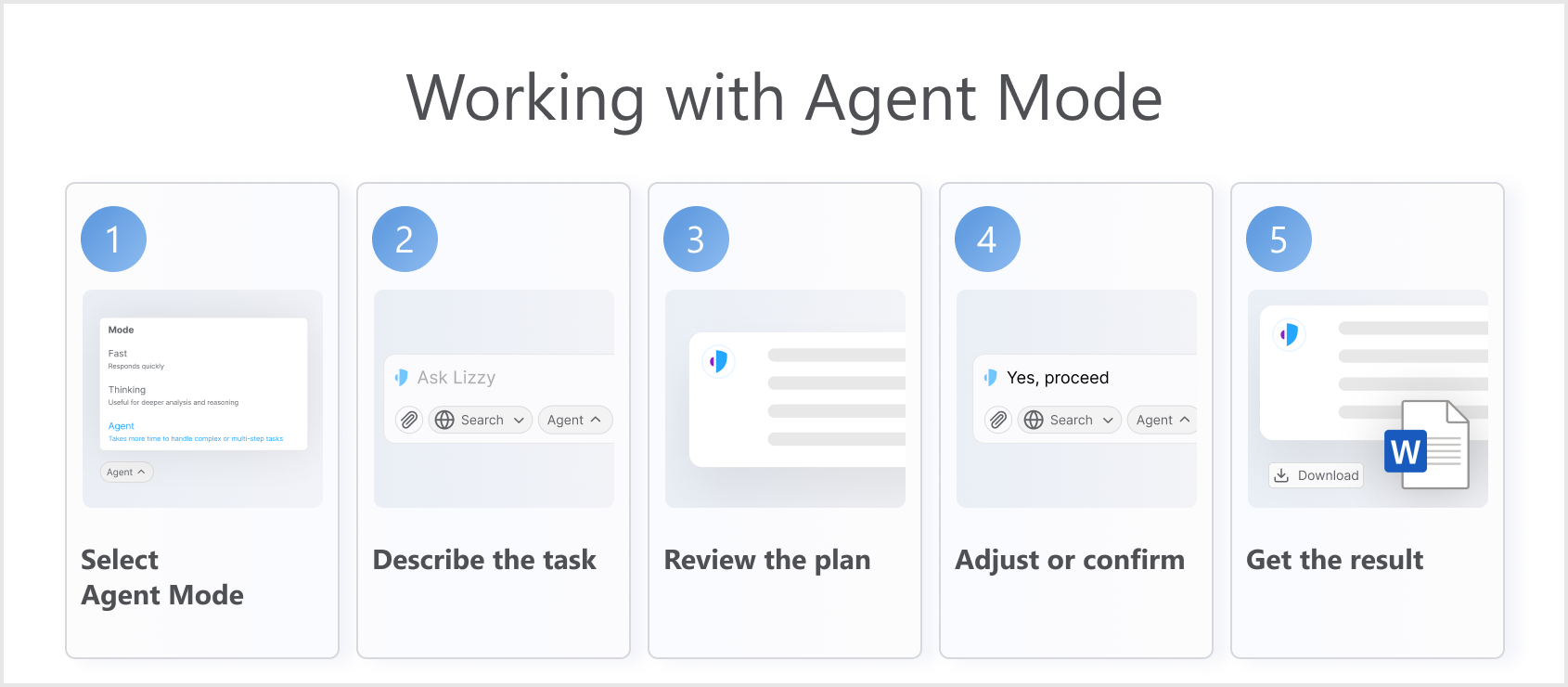
Agent Mode is a new operational mode in LizzyAI for complex, multi-step legal tasks. It breaks complicated work into sub-tasks and executes them sequentially, with consistent depth. That execution-first design is what makes it especially strong for long documents, contract review playbooks, and scenarios where missing one instruction means missing the point.
Fast vs Thinking vs Agent Mode (and why Agent wins on long, multi-instruction reviews)
Say you ask: “Run a full contract review playbook on this M&A agreement.”
Fast mode: quick, useful, but inherently compressed
Fast mode is optimized for speed. It will typically produce a solid high-level analysis or issue-spotting summary, but when you stack multiple instructions (like a full playbook) on top of a long document, the response can become compressed. That is where coverage can get uneven - some sections get attention, others get less, and nuanced sub-instructions can blur together.
Thinking mode: deeper reasoning, better prioritization
Thinking mode adds more deliberate reasoning steps. Instead of jumping straight to conclusions, it works through the problem more carefully - which generally improves accuracy, prioritization, and explanation quality. It is a strong fit when you want a deeper analysis of a clause or a more careful legal reasoning chain across a document.
Agent Mode: takes Thinking further with step-by-step execution and iteration
Agent Mode takes the benefits of Thinking mode to the next level by shifting from “produce a single response” to “execute a workflow.” It is designed to reduce common model constraints by:
- Running the review in explicit steps (rather than compressing everything into one pass)
- Allowing iteration and loops (for example, revisiting an earlier conclusion after later sections add context)
- Being more thorough on long documents by completing sequential sub-tasks with consistent depth
In practice, that means Agent Mode can handle a full playbook with stronger coverage and fewer blind spots, especially when the document is long and the instructions are layered.
Better handling of multiple instructions (the playbook problem)
A contract review playbook is essentially a stack of instructions that must be processed in order. Agent Mode is built for that reality: it breaks the workload into sub-tasks and executes them sequentially, reducing the chance of instruction drop-off and improving completeness.
This is particularly relevant for Legal AI use cases like:
— Reviewing a DPA against a predefined set of review instructions
— Reviewing a rider to a real-estate agreement against a pre-approved changes rider
— Running firm-approved review workflows across different agreement types
Light-touch confirmation, without slowing you down
Agent Mode can show you the steps before it executes, so you can confirm the direction and optionally adjust emphasis (for example, “in indemnification, focus on tax indemnities and survival periods”). This is intentionally lightweight: the core gain is still the execution model - structured, sequential, and iterative when needed.
Designed for legal work, inspired by “agents” elsewhere
Agent Mode is LizzyAI’s legal-first answer to the agent wave in software (think coding agents). But instead of optimizing for writing code, it is tuned for legal workflows: contract review, transaction pager creation, and litigation document preparation. The result is Legal AI that is not just smart, but operationally reliable.
The takeaway: more coverage, fewer blind spots, higher confidence
If you mostly need speed, Fast mode is excellent. If you need deeper reasoning, Thinking mode is a great upgrade. But if your main concern is accuracy through completeness - especially on long contracts and multi-instruction reviews - Agent Mode is built to be the most thorough way to run Legal AI in Lizzy.
How to Get Started